WAKE UP AMERICA!

Sharman Ramsey, Betty Peters and Barbara Moore, are grandmothers on the Frontline in the Battle for the Heart and Mind of America. Our children are the target of the enemies of America and our way of life. Their aim is to steal the hearts and minds of our children and undermine America through the destruction of the basic institutions of our country (schools, government, churches) including the American family.

Sunday, October 23, 2022

DIVERSITY, EQUITY AND INCLUSION. MARXISM N OUR SCHOOLS


Just in case you thought we have misrepresented what is going on in our schools, read this. A group of parents viewed Teaching Tolerance produced by the Southern Poverty Law Center in the early 90s. They were using it then. I have sent you the reading scores in a separate email with scores that are abominable. Remember DEI is Diversity, Equity and Inclusion. You can see how our schools are controlled from above, not by the citizens here who support those schools. 

Who is Paolo Freire? He is a former Jesuit defrocked priest who participated in Liberation Theology in Nicaragua and then was introduced to the leading Marxists in our country where they decided education was the way to infuse Marxism into the people of America and produced Liberation Pedagogy. Please notice the mention of Paolo Freire in one of the screen shots Barbara Moore took and shared with me. BARBARA  ACCESSED DOTHAN SCITY SCHOOL'S EQUITY ACTION PLAN AND THIS IS WHAT SHE FOUND!

Notice the mention of Howard Zinn's textbook. It is a diatribe of hatred toward America. And many districts adopt it because this is what is coming out of the Department of Education and colleges of education. If you want to advance in the world of education you had better be ready to parrot this philosophy. 

I share these things with you because there is a battle for the American mind. If you have children in our public schools or not, your taxes are supporting this. And you must live with the consequences. I do not want you defenseless. Please notice this information was posted by a woman who is apparently well-paid as a "Better Lesson Coach". And we wonder why our children have trouble reading and doing math?

    REMEMBER YOUR TAX DOLLARS PAY FOR THIS! DOES THAT MAKE YOU JUST AS CULPABLE AS THESE WHO ARE UNDERMINING OUR CHILDREN?


In 1923, Lenin recognized the Socialist Movement would not spread to industrialized nations so he brought together a group of scholars to retool their strategy. To camouflage its nature they called it the Institute of Social Research. This group has also been known as the Frankfurt Group. Key members of the group moved to the US, mainly Columbia University. In the US they developed what they called "Critical Theory." They designed it as a strategy to change, revolutionize, and bring down America by criticizing it. 

Marcuse ... advocated the "long march through the institutions" and recommended educational institutions as a refuge for radicals in the US.

The Frankfurt School was a significant influence on Paolo Freire in the conception of critical pedagogy, alongside influences from orthodox Marxism. Critical pedagogy was meant initially to address the needs of peasants resisting oppression rather than students in the United States, who attend universities as part of a process of entering the social or economic elite. Amidst the decline of the New Left, the rise of neoconservatism, and the election of Ronald Reagan,  animated by Aronowitz's reminder of Marx's dictum, "the ultimate task of philosophy and theory was not merely to 'comprehend reality' but to change it", Henry Giroux sought to make the university classroom a site for class struggle. Giroux drew on the work of Gramsci and the British cultural marxists in conceiving of teachers as a revolutionary vanguard. Alongside Michael Apple, Giroux popularized Freire in educational studies, to the point that Freirian language and techniques of critical pedagogy became ubiquitous in liberal arts classrooms of the 1990s. The value of these practices were questioned in the broader cultural conversation on political correctness.

McLaren has developed a social movement based version on critical pedagogy that he calls revolutionary critical pedagogy, emphasizing critical pedagogy as a social movement for the creation of a democratic socialist alternative to capitalism.

In 1992, Maxine Hairston took a hard line against critical pedagogy in the first year college composition classroom and argued, "everywhere I turn I find composition faculty, both leaders in the profession and new voices, asserting that they have not only the right, but the duty, to put ideology and radical politics at the center of their teaching.

Though no one has as yet surveyed how far social justice teaching has pervaded America’s 1,500 ed schools, education researchers David Steiner (now Hunter College ed-school dean) and Susan Rozen did a study two years ago on the syllabi of the basic “foundations of education” and “methods” courses in 16 of the nation’s most prestigious ed schools. The mainstays of the foundations courses were works by Paolo Freire, Henry Giroux (a leading critical pedagogy theorist), and the radical education writer Jonathan Kozol (“America’s Most Influential—and Wrongest—School Reformer,” Winter 2000) 
 
If you see, Paulo Freire's book, Pedagogy of the Oppressed or Ken Goodman's Whole Language Catalog, you can be guaranteed your university is producing radicals not educators. 
 

CRITICAL PEDAGOGY and Bill Ayers (domestic terrorist and Obama's boss at the Chicago Anenburg Project). Ayers’s spectacular second act began when he enrolled at Columbia University’s Teachers College in 1984. Then 40, he planned to stay just to get a teaching credential. (He had taught in a “Freedom School” during his pre-underground student radical days.) But he experienced an epiphany in a course taught by Maxine Greene, a leading light of the “critical pedagogy” movement. As Ayers wrote later, he took fire from Greene’s lectures on how the “oppressive hegemony” of the capitalist social order “reproduces” itself through the traditional practice of public schooling—critical pedagogy’s fancy way of saying that the evil corporations exercise thought control through the schools.

Critical pedagogy theorists nurse a rancorous view of an America in which it is always two minutes to midnight and a knock on the door by the thought police is imminent. The education professors feel themselves anointed to use the nation’s K–12 classrooms to resist this oppressive system. Thus Maxine Greene urged teachers not to mince words with children about the evils of the existing social order. They should portray “homelessness as a consequence of the private dealings of landlords, an arms buildup as a consequence of corporate decisions, racial exclusion as a consequence of a private property-holder’s choice.” In other words, they should turn the little ones into young socialists and critical theorists.

The reading list for his urban education course includes the bible of the critical pedagogy movement, Brazilian Marxist Paolo Freire’s Pedagogy of the Oppressed; two books by Ayers himself; another by bell hooks, a radical black feminist writer and critical race theorist; and a “Freedom School” curriculum. That’s the entire spectrum of debate.


Sunday, October 16, 2022

Betty Peters on transgenderism and sex education in 2015

 Notice that this was written in 2015. How prescient Betty was! Common Core is still here. On steroids. 

But called something else!


Betty Peters

Michelle Mann

That Betty Peters has nothing good to say about Common Core standards is not a secret. The Alabama School Board District 2 member was clear in her opinion when she addressed members of the Coffee County Republican Women Oct. 21.

Common Core, a set of standards developed by the National Governors Association and the Council of Chief State School Officers, has been a topic of controversy since November 2010 when the Alabama state school board voted 7-2 to align the state course of study for reading and math with Common Core standards.

Peters voted against Common Core and said she would continue the fight against it.

While Common Core was designed to help students meet English and math grade level standards to prepare for college, Peters said it is not working and that the problems extend well beyond just the curriculum.

Peters said the standards were a federal intrusion into states’ rights to set their own education standards. Peters said although the standards were set by the states, funding initiatives by the federal government made them a de facto “federal takeover” of education.

“I understand Alabama, Arkansas, Mississippi are the three Southern states targeted by the radical, left, homosexualists to change our students’ perspective,” Peters said. “We have gone past gay, lesbian and bi-sexual and we’re now into gender fluid spectrum.”

Peters said the Southern Poverty Law Center is among the groups filtering informational texts involving sexuality and sexual orientation into the curriculum. They argue that the information is vital for diversity and tolerance, Peters said, adding that in her opinion it is raising even bigger concerns.

“The Southern Poverty Law Center is going to be developing your children or grandchild or neighbors’ children into little social activists for social justice, as they define it, or else transgender stuff,” Peters said, as she distributed a coloring book sheet with pictures of a variety of clothing items.

“This is part of teaching tolerance for transgenderism to four to eight year olds,” Peters said. “The students are given color crayons and two handouts. They students are supposed to color the photos of the clothes they want to wear.

“You will notice these are called outfits,” Peters said. “I have never asked my son or my husband what ‘outfit’ they are going to wear. This is just crazy. I think all this stuff is mainly written by whacky feminists.

“When you start complaining about this, the first thing you are going to hear is ‘that’s not part of Common Core,’” Peters said. “No, it’s not but it is aligned with it and it is allowed to be part of Common Core because it is informational text and teaching tolerance.”

Peters also distributed a handout with a Common Core math problem on it. “It’s one example of what I call stupid ways to do math,” Peters said. “It’s called counting up. They are not teaching the way we learned and golly, we did pretty well with our old math. We got to the moon, done a lot of medical research, making movies, all sorts of stuff.

“I’ve tried to get it changed and I will continue to try to get it changed because this is something that the parents cannot help their child with,” Peters said. “I didn’t vote for it but the state school board majority voted to have the Common Core with informational text included. You can get all sorts of mess with informational text.

“As I said when I first campaigned and I’ve said it every time since, we need to get back to the basics: Reading, writing and arithmetic from first grade on,” Peters said. “We need to be teaching the ‘c’ part which is Christian values, not Muslim values, not transgender values. We need to be teaching the old Biblical values.

“I’m sorry the Common Core happened under my watch. A lot of this is not a part of the Common Core but the Common Core allows it,” Peters said. “It’s time for Americans to stand up for this infringement of parental rights. They give us PowerPoint (presentations) with charts to make everything look credible but the assignments for these children from the Southern Poverty Law Center are just so stupid.

“Our nation has gone to Gomorrah and it’s up to us to turn it around,” she said referring to one of two ancient cities near the Dead Sea that were cited in the Bible as being destroyed by God as a punishment for the wickedness of their inhabitants. “There are enough voters out there who think like we do and we have just got to take our children back.

“Stand up. Don't be afraid of upsetting the school. The schools cannot exist without students. It’s your responsibility to shield your child and preserve his or her innocence as long as you can,” Peters said. “They’re growing up way too fast and it’s not good.”

·   


Tuesday, August 23, 2022

Comprehensive Sex Education Undermines Students’ Moral Development


Comprehensive Sex Education Undermines Students’ Moral Development

Though its practitioners may be well-intentioned, comprehensive sex education does not offer a solution to sexual exploitation. On the contrary, it is part of the problem, since it fails to develop students’ capacity to differentiate between genuine love and sexual exploitation.

Does comprehensive sex education make children vulnerable to sexual exploitation?

The systematic sexual exploitation of 1400 children in Rotherham between the years 1997 and 2013, as well as widespread child abuse in other English towns, has led to an independent inquiry and several serious case reviews. These have been analyzed by Norman Wells, the director of the UK organization Family Education Trust, in his 2017 book Unprotected: How the normalization of underage sex is exposing children and young people to the risk of sexual exploitation.

According to the UK government definition, child sexual exploitation

occurs when an individual or group takes advantage of an imbalance of power to coerce, manipulate or deceive a child or young person under the age of 18 into sexual activity (a) in exchange for something the victim needs or wants, and/or (b) for the financial advantage or increased status of the perpetrator or facilitator. The victim may have been sexually exploited even if the sexual activity appears consensual.

Wells refers to Alexis Jay’s Independent Inquiry into Child Sexual Exploitation in Rotherham between 1997–2013. According to this report, children, including girls as young as eleven were

  • raped by multiple perpetrators trafficked to other towns and cities in the north of England
  • abducted, beaten, and intimidated in some cases, doused in petrol and threatened with being set alight,threatened with guns,made to witness brutally violent rapes, and threatened that they would be next if they told anyone.

The authorities in Rotherham were complacent toward underage sexual activity, because they assumed that young people were making a lifestyle choice. The Rotherham Inquiry pointed out that “children as young as 11 were deemed to be having consensual sexual intercourse when in fact they were being raped and abused by adults.” The concerns raised by some of the parents were dismissed by the authorities. “In two of the cases . . . fathers tracked down their daughters and tried to remove them from houses where they were being abused, only to be arrested themselves when police were called to the scene.” The social workers thought that the concerned parents were not able to accept their children growing up. According to Wells,

“Comprehensive sex and relationship education” has created in young people the expectation that they will have a series of casual sexual relationships. Within this culture, sexual exploitation has been allowed to go undetected and vulnerable young people have been deprived of protection.

In the foreword to Wells’s book, Nottingham University Business School professor David Paton concludes:

A clear picture emerges of a culture in which underage sexual activity has come to be viewed as a normal part of growing up and seen as relatively harmless as long as it is consensual. Combined with official policies to encourage the confidential provision of contraception to minors, it becomes clear that current approaches aimed at improving teenage sexual health have frequently facilitated and perpetuated the sexual abuse of vulnerable young people.

Paton argues that “policymakers and professionals working in sexual health no longer have any excuse to ignore the evidence.” These are serious accusations. But what, exactly, are Paton and Wells condemning? What’s so bad about comprehensive sex education?

Separating Sex from Love—and Morality

Both Paton and Wells imply that the basic problem with comprehensive sex education is its amoral and relativistic approach, which separates human sexuality from its inherent connection with married love. This criticism has been philosophically developed by Dietrich von Hildebrand.

Von Hildebrand points out that instead of fostering objectivity, critical thinking, and autonomy, amoral sex education fails to develop young people’s potential for value-response and thereby fails to contribute to the unfolding of their human potential in general. Insofar as their moral capacity remains undeveloped, they become incapable of discerning and resisting sexual exploitation.

Von Hildebrand regarded the cultivation of value-responses such as love, faithfulness, admiration, veneration, and reverence as central for sex education. Separated from moral values, sex education becomes a way of narrowing and cramping the human personality. Amoral sex education undermines students’ moral agency, their capacity to evaluate desires, consider reasons, form intentions, and make and implement decisions based on their value experience. It fails to support the development of morally conscious persons capable of forming mature moral judgments based on their perception of values as moral agents who can make evaluative judgments without succumbing to relativism.

Morally “neutral” sex education teaches that there are no absolute sexual norms: all forms of sexual behavior based on mutual consent are normal and acceptable. In a sense, young people are left to decide for themselves. But insofar as there are no adequate normative criteria to help them choose among competing lifestyles, their choices will not be free in any meaningful sense of the term. Instead, their choices will be arbitrary, based on only the whim of the moment, as Hanan Alexander points out. When all sexual alternatives are presented as of equal value, young people will find it difficult to perceive the different moral implications and social consequences of various lifestyles.

Sexual experimentation numbs the sensitivity needed to perceive the true nature of love and the values inherent in it.

Amoral Sex Education Dulls Moral Sensitivity

The problem is not merely the reductive and neutralizing nature of amoral sex education, but the distortion of the personal, individual, and intimate nature of sexuality. Amoral sex education obscures the fact that sexuality receives its genuine significance in the unique life-long love relationship between married spouses based on total and irrevocable self-donation.

Because of its “objective” and biologically reductive approach, amoral sex education tends to use explicit sexual material, which violates young people’s moral sensitivity and natural modesty and thereby undermines their capacity for moral agency. It deprives children of their natural innocence, which includes freedom from sexual thoughts, images, desires, and behaviors. It undermines their capacity for what von Hildebrand calls “noble shame” or modesty, “which conceals something because it is particularly intimate.” The latter is grounded in the privacy and intimacy of sex and “in the intrinsic awe it inspires, awe of its extraordinary and mysterious quality,” as well as in “an instinctive dislike of the impudent, the irreverent, the defiling and the sinister.”

Undermining young people’s natural awareness that sexuality is personal, individual, and intimate can have negative effects. It can encourage a promiscuous lifestyle, make it more difficult to resist sexual abuse, and generally weaken the ability to resist one’s own impulses. Separated from love, von Hildebrand writes, sexuality becomes “an intoxicating charm which draws man down to the animal level, a desecration of the great gift of sex—in short, a mystery of iniquity.” The “objective” representation of sex, devoid of moral values, “offends our sense of modesty because it takes no account of this shyness.”

Protecting children’s natural innocence is justified by pedagogical considerations as well. Sexualized children slip from their parents’ guidance, which threatens good parent-child relationships. Even Sigmund Freud admitted that the sexualization of children hampers their education: “We have seen from experience that seductive external influences can cause premature breach of the latent stage or its extinction . . . and that any such premature sexual activity impairs the educability of the child.”

Amoral Sex Education Undermines Moral Agency

Without a moral framework, young people do not have adequate criteria for choosing between competing life styles, which means that their choices become arbitrary. Amorality misrepresents the nature of human sexuality even more radically than immorality. The amoral approach neglects the very categories of morally right and wrong and thereby fails to foster the basic preconditions of human agency.

This is not a merely intellectual problem. It is an existential one.

The neutralizing sex education received at school undermines young people’s ability to comprehend the deep moral implications of sexual behavior. It makes them insensitive to moral distinctions by conveying the impression that there are no absolute sexual norms: all forms of sexual behavior based on mutual consent are regarded as normal and acceptable. Thus, neutralizing sex education deprives young people of the capacity to distinguish between genuine love and exploitative sexuality.

By reducing sexuality to a biological instinct, amoral sex education produces people who are guided by what is subjectively satisfying and controlled by their drives, appetites, and desires, rather than by what is intrinsically valuable. It fails to help young people to achieve moral transcendence and develop as persons guided by value-response. A biologically reductive sex education not only fails to develop young people’s capacity for the transcendence implicit in a value-responding attitude, it also fails to provide the preconditions for the development of their authentic subjectivity. Instead of becoming more alive, they become alienated from themselves.

Though its practitioners may be well-intentioned, comprehensive sex education does not offer a solution to sexual exploitation. On the contrary, it is part of the problem, since it fails to develop students’ capacity to differentiate between genuine love and sexual exploitation. What is needed is a form of sexual education that is oriented to married love and the virtues required by a stable nuclear family.

sex education curricula,…
  • ducation and the Seduction of Selective Science
  • Monday, August 15, 2022

    University Had Short Attention Span for Super Teaching


    The University of Alabama in Huntsville recently dissolved a contract with a self-styled business guru — who had a history of fraudulent business practices — to help develop a piece of teaching technology aimed primarily at K-12 students. But some observers are wondering why it took the university six months to terminate the relationship after unsavory details of the entrepreneur’s past came to light — and why due diligence did not stop the university from signing the contract in the first place.

    The university went into business in 2007 with Bernard Dohrmann — an entrepreneur who has a long history of run-ins with federal watchdogs, including two convictions — to help monetize a tool called Super Teaching. It entered into a contract in December of that year with a company called Life Success Academy, headed by Dohrmann and his wife, as well as another company called Monte Sano Associates, to help test and improve the Super Teaching hardware.

    Super Teaching is a system of teaching purportedly designed to harness the short attention spans of today’s students. It does this by projecting images onto three screens at the front of the classroom, and rotating slides related to the lesson with various unrelated images so as to stimulate the brain into a state of optimal receptivity, according to promotional materials.

    In return for studying and improving the Super Teaching system, Alabama-Huntsville would collect a share of the revenue once the system, which was projected to cost at least tens of thousands of dollars per classroom, was turned into a commercial product, according to a copy of the contract that the university provided to Inside Higher Ed.

    Things never made it that far. The university dissolved its relationship with Life Success Academy and Monte Sano Associates two months ago, without Super Teaching ever being sold as a product. According to Kannan Grant, the director of technology commercialization at the university and one of the signatories of the contract, the university backed out because “there was no market for it.”

    In the end, nobody made a buck from the deal, including the university. Alabama-Huntsville officials say that, since Dohrmann set up the equipment for free, the university didn’t lose any money, either — except, perhaps, for the labor hours of university employees charged with improving the system.

    Pals with a convicted ‘con man’

    Still, some observers believe that Alabama-Huntsville should have ended its deal with the Dohrmanns much earlier, and for different reasons. Six months earlier Brian LeCompte, an engineer and Huntsville alumnus who runs a political blog called Flashpoint, wrote a lengthy post enumerating Dohrmann’s history of shady dealings and sharply criticizing the university for legitimating the work of a “huckster” whom “most reputable institutions wouldn’t touch with a ten-foot pole.” The student newspaper at Huntsville followed up a month and a half later with an article headlined “Learning at the Speed of Con.”

    Both accounts referred to a 2002 San Francisco Chronicle article outlining the history of legal troubles surrounding Dohrmann’s moneymaking ventures. The article, written after Dohrmann re-emerged as an organizer of expensive business seminars in Los Angeles, reported that he had been convicted for illegal business practices twice — once in 1975, for securities fraud, and again in 1995, for misrepresenting sales figures to investors in one of his companies. The Securities and Exchange Commission also charged Dohrmann with deceptive sales practices in 1982, in connection with his work for an investment diamond retailer, but he settled out of court. After his 1995 conviction, a U.S. attorney called Dohrmann a “very dangerous con man.”

    Attempts to reach Dohrmann at Life Success Academy were unsuccessful, as the company is no longer listed at the address indicated by the contract with the university. Dohrmann did not reply to multiple e-mail and Facebook messages seeking comment.

    The Chronicle article quotes Dohrmann’s wife, Lynn, as saying she and her husband hoped to “get Super Teaching classrooms into schools all across America.”

    At the beginning of the university’s partnership with the Dohrmanns, the campus leadership appeared to share this vision. In a video posted a year ago to YouTube, purportedly from a university source, David B. Williams, the university’s president, is heard in a voiceover saying, “We are perhaps better suited than any other university in this country to be the lead in helping to bring Super Teaching to the rest of the world.”

    Pleading ignorance

    Several Alabama-Huntsville officials close to the 2007 deal with Life Success Academy told Inside Higher Ed that they were not aware of Dohrmann’s history of legal indiscretions before signing the Super Teaching contract.

    “That’s totally immaterial,” said Wilson Luquire, CIO and dean of the library at the university. “People are not vetted for their past, that’s not our normal process here.”

    Luquire was the one to whom Dohrmann originally pitched the idea of having the Huntsville campus act as a proving ground for the Super Teaching system, according to a university spokesman. “I’m a big proponent of a venture that would make the university money,” Luquire said. “We all have to be in these budget times.” He refused to answer further questions.

    The contract empowered the university to terminate the agreement at any time, for any reason.

    As for the time that elapsed after Dohrmann’s legal history came to light and before the contract was terminated: “Could it have been shorter? Maybe, maybe not,” said Grant, the director of technology commercialization. “It just took six months. And I think that’s because the product — there was no market for it.”

    Asked why the university did not hastily end its relationship with Dohrmann’s company once his checkered past came to light, a university spokesman, Ray Garner, said its officials were too distracted by other issues, such as budget cuts and the Amy Bishop shootings, which occurred in February, to worry about it.

    “Our campus has experienced some very real challenges in recent months, and while some may view this issue as important, we have had to deal with other, more pressing matters,” Garner said. He did not elaborate on why fallout from the shootings would affect any technology commercialization contracts.

    One person who does view the issue as important is Betty Peters, a member of the Alabama School Board. Peters says Dohrmann’s history of defrauding clients does not inspire much confidence that Super Teaching would be a good investment for any school that might have bought it, and was disturbed by the idea that if the system had been successfully packaged as a commercial product, the University of Alabama in Huntsville would profit from sales of the units to taxpayer-supported primary and secondary schools and community colleges.

    “UAH is known as an engineering school,” Peters said in an interview. “They have strong ties with NASA. … If they’re going to be selling something for our schools that’s a waste of money, that would be unbecoming to a public university at best," she said. Williams, who before coming to Huntsville was vice provost for research at Lehigh University, “should know better” than to affiliate the university with such “funny business,” Peters said.

    “We didn’t necessarily think it was a fraudulent product,” Grant says. In fact, another video, posted to YouTube by the same purportedly university-affiliated source as the one bearing Williams’s ringing endorsement, shows Luquire, the Huntsville CIO and library dean, announcing that the university had redesigned the Super Teaching hardware unit to be more compact. In the video, Luquire says the improvements would reduce the projected per-classroom retail price of $200,000 by two-thirds.

    The contract holds the university harmless from any lawsuits levied against the purveyors of the new-age system by dissatisfied customers.

    Jury still out on effectiveness

    Super Teaching’s most outspoken champion in academe is Lee Pulos, a member of the American Psychology Association who “has conducted over 200 corporate seminars for Fortune 500 companies on Qualities of High Performance Persons, The Power of Visualization, and The Role of Intuition in Decision Making,” according to his website.

    Pulos has vouched for the scientific merits of Super Teaching. In one paper, he cites past studies where the brains of rats and primates showed measurable cell growth when exposed to “hyperstimulation,” one of the bedrock concepts behind Dohrmann’s system.

    Still, there is little available experimental data on the system’s effectiveness. In 2002, at least two institutions — an elementary school in Michigan and Salt Lake Community College in Utah — ran Super Teaching pilots. Officials at the school in Michigan said they could not track down anyone with direct knowledge of that pilot or any data that might have come out of it, citing personnel turnover.

    Kurt Shirkey, the director of media services and electronic classrooms at Salt Lake Community College, was originally hired in 2002 to oversee the Super Teaching system there. During the four years the college used the system — before deeming it obsolescent and abandoning it in 2006 — Shirkey collected survey data on student and faculty opinions about the technology. He says faculty thought it was “OK,” though some were irked by having to learn how to use it, and that students generally liked it — particularly the music and videos that the system played as they were entering and leaving the classroom. However, according to Shirkey, Salt Lake never formally studied the effect of Super Teaching on learning outcomes.

    The impact of the Super Teaching system on student performance was being studied by a graduate student at the University of Alabama in Huntsville — and in fact still is, according to a source at the university who asked not to be named. The data from that student’s research has been collected, said the source, but the analysis has yet to be approved.

    None of the student’s findings have been published, leaving the question of pedagogical merit — the question that lies at the heart of the debate over Super Teaching in Huntsville — unanswered. For now, that is. 

    Read more…  University Had Short Attention Span for Super Teaching

    Math Problems: Knowing, Doing, and Explaining Your Answer by Barry Garelick and Katharine Beals


    Math Problems: Knowing, Doing, and Explaining Your Answer
    by Barry Garelick and Katharine Beals

    At a middle school in California, the state testing in math was underway via the Smarter Balanced Assessment Consortium (SBAC) exam. A girl pointed to the problem on the computer screen and asked “What do I do?” The proctor read the instructions for the problem and told the student: “You need to explain how you got your answer.”

    The girl threw her arms up in frustration and said, “Why can’t I just do the problem, enter the answer and be done with it?”

    The answer to her question comes down to what the education establishment believes “understanding” to be, and how to measure it. K-12 mathematics instruction involves equal parts procedural skills and understanding. What “understanding” in mathematics means, however, has long been a topic of debate. One distinction popular with today’s math reform advocates is between “knowing” and “doing.” A student, reformers argue, might be able to “do” a problem (i.e., solve it mathematically), without understanding the concepts behind the problem solving procedure. Perhaps he has simply memorized the method without understanding it.

    The Common Core math standards, adopted in 45 states and reflected in Common Core-aligned tests like the SBAC and the PARCC, take understanding to a whole new level. “Students who lack understanding of a topic may rely on procedures too heavily,” states the Common Core website. “… But what does mathematical understanding look like?” And how can teachers assess it?

    “One way … is to ask the student to justify, in a way that is appropriate to the student’s mathematical maturity, why a particular mathematical statement is true or where a mathematical rule comes from.” (http://www.corestandards.org/Math/).

    The underlying assumption here is that if a student understands something, she can explain it—and that deficient explanation signals deficient understanding. But this raises yet another question: what constitutes a satisfactory explanation?

    While the Common Core leaves this unspecified, current practices are suggestive: Consider a problem that asks how many total pencils are there if 5 people have 3 pencils each. In the eyes of some educators, explaining why the answer is 15 by stating, simply, that 5 x 3 = 15 is not satisfactory. To show they truly understand why 5 x 3 is 15, and why this computation provides the answer to the given word problem, students must do more. For example, they might draw a picture illustrating 5 groups of 3 pencils.

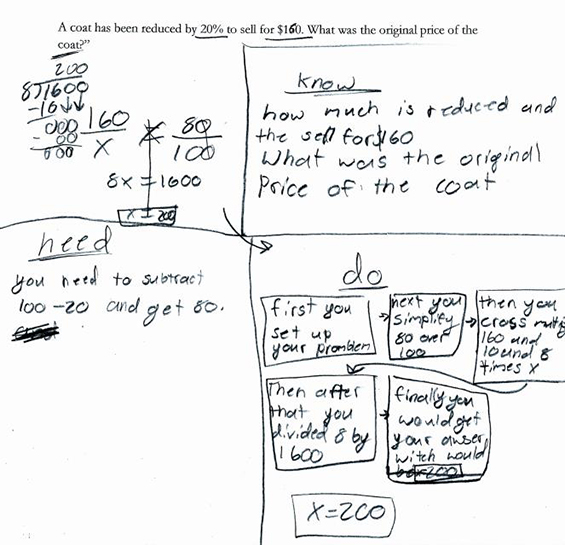
    Consider now a problem given in a pre-algebra course that involves percentages: A coat has been reduced by 20% to sell for $160. What was the original price of the coat?”

    A student may show their solution as follows:

    x = original cost of coat in dollars
    100% – 20% = 80%
    0.8x = $160
    x = $200

    Clearly, the student knows the mathematical procedure necessary to solve the problem. In fact, for years students were told not to explain their answers, but to show their work, and if presented in a clear and organized manner, the math contained in this work was considered to be its own explanation. But the above demonstration might, through the prism of the Common Core standards, be considered an inadequate explanation. That is, inspired by what the standards say about understanding, one could ask “Does the student know why the subtraction operation is done to obtain the 80% used in the equation or is he doing it as a mechanical procedure — i.e., without understanding?”

    Providing instruction for explanations—the road to “rote understanding”

    In a middle school observed by one of us, the school’s goal was to increase student proficiency in solving math problems by requiring students to explain how they solved them. This was not required for all problems given; rather, they were expected to do this for two or three problems per week, which took up to 10 percent of total weekly class time. They were instructed on how to write explanations for their math solutions using a model called “Need, Know, Do.” In the problem example given above, the “Need” would be “What was the original price of the coat?” The “Know” would be the information provided in the problem statement, here the price of the discounted coat and the discount rate. The “Do” is the process of solving the problem.

    Students were instructed to use “flow maps” and diagrams to describe the thinking and steps used to solve the problem, after which they were to write a narrative summary of what was described in the flow maps and elsewhere. They were told that the “Do” (as well as the flow maps) explains what they did to solve the problem and that the narrative summary provides the why. Many students, though, had difficulty differentiating the “Do” section from the final narrative. But in order for their explanation to qualify as “high level,” they couldn’t simply state “100% – 20% = 80%”; they had to explain what that means. For example, they might say, “The discount rate subtracted from 100% gives the amount that I pay.”

    An example of a student’s written explanation for this problem is shown in Figure 1: Example of student explanation.

    For problems at this level, the amount of work required for explanation turns a straightforward problem into a long managerial task that is concerned more with pedagogy than with content. While drawing diagrams or pictures may help some students learn how to solve problems, for others it is unnecessary and tedious. As the above example shows, the explanations may not offer the “why” of a particular procedure.

    Under the rubric used at the middle school where this problem was given, explanations are ranked as “high”, “middle” or “low.” This particular explanation would probably fall in the “middle” category since it is unlikely that the statement “You need to subtract 100 -20 to get 80” would be deemed a “purposeful, mathematically-grounded written explanation.”

    The “Need” and “Know” steps in the above process are not new and were advocated by Polya (1957) in his classic book “How to Solve It”. The “Need” and “Know” aspect of the explanatory technique at the middle school observed is a sensible one. But Polya’s book was about solving problems, not explaining or justifying how they were done. At the middle school, however, problem solving and explanation were intertwined, in the belief that the process of explanation leads to the solving of the problem. This conflation of problem solving and explanation is based on a popular educational theory that being aware of one’s thinking process — called “metacognition” — is part and parcel to problem solving (see Mayer, 1998).

    Despite the goal of solving a problem and explaining it in one fell swoop, in many cases observed at the middle school, students solved the problem first and then added the explanation in the required format and rubric. It was not evident that the process of explanation enhanced problem solving ability. In fact, in talking with students at the school, many found the process tedious and said they would rather just “do the math” without having to write about it.

    In general, there is no more evidence of “understanding” in the explained solution, even with pictures, than there would be in mathematical solutions presented in a clear and organized way. How do we know, for example, that a student isn’t simply repeating an explanation provided by the teacher or the textbook, thus exhibiting mere “rote learning” rather than “true understanding” of a problem-solving procedure?

    Requiring explanations undoes the conciseness of math

    Math learning is a progression from concrete to increasingly abstract. The advantage to the abstract is that the various mathematical operations can be performed without the cumbersome attachments of concrete entities — entities like dollars, percentages, groupings of pencils. Once a particular word problem has been translated into a mathematical representation, the entirety of its mathematically-relevant content is condensed onto abstract symbols, freeing working memory and unleashing the power of pure mathematics. That is, information and procedures handled by available schemas frees up working memory. With working memory less burdened, the student can focus on solving the problem at hand (Aditomo, 2009). Thus, requiring explanations beyond the mathematics itself distracts and diverts students away from the convenience and power of abstraction. Mandatory demonstrations of “mathematical understanding,” in other words, impede the “doing” of actual mathematics.

    “I can’t do this orally, only headily”

    The idea that students who do not demonstrate their strategies in words and pictures must not understand the underlying concepts assumes away a significant subpopulation of students whose verbal skills lag far behind their mathematical skills, such as non-native English speakers or students with specific language delays or language disorders. These groups include children who can easily do math in their heads and solve complex problems, but often will be unable to explain — whether orally or in written words — how they arrived at their answers.

    Most exemplary are children on the autistic spectrum. As autism researcher Tony Attwood has observed, mathematics has special appeal to individuals with autism: it is, often, the school subject that best matches their cognitive strengths. Indeed, writing about Asperger’s Syndrome (a high functioning subtype of autism), Attwood notes that “the personalities of some of the great mathematicians include many of the characteristics of Asperger’s syndrome.” (Attwood, 2007)

    And yet, Attwood adds (ibid.), many children on the autistic spectrum, even those who are mathematically gifted, struggle when asked to explain their answers. “The child can provide the correct answer to a mathematical problem,” he observes, “but not easily translate into speech the mental processes used to solve the problem.” Back in 1944, Hans Asperger, the Austrian pediatrician who first studied the condition that now bears his name, famously cited one of his patients as saying that, “I can’t do this orally, only headily” (Asperger, H., 1991 [1944]).

    Writing from Australia decades later, a few years before the Common Core took hold in America, Attwood adds that it can “mystify teachers and lead to problems with tests when the person with Asperger’s syndrome is unable to explain his or her methods on the test or exam paper” (Attwood, 2007, p. 241). Here in post-Common Core America, this inability has morphed into an unprecedented liability.

    Is it really the case that the non-linguistically inclined student who progresses through math with correct but unexplained answers — from multi-digit arithmetic through to multi-variable calculus — doesn’t understand the underlying math? Or that the mathematician with the Asperger’s personality, doing things headily but not orally, is advancing the frontiers of his field in a zombie-like stupor?

    Or is it possible that the ability to explain one’s answers verbally, while sometimes a sufficient criterion for proving understanding, is not, in fact, a necessary one?

    What is really being measured?

    Measuring understanding, or learning in general, isn’t easy. What testing does is measure “markers” or byproducts of learning and understanding. Explaining answers is but one possible marker.

    Another, quite simply, are the answers themselves. If a student can consistently solve a variety of problems, that student likely has some level of mathematical understanding. Teachers can assess this more deeply by looking at the solutions and any work shown and asking some spontaneous follow-up questions tailored to the child’s verbal abilities. But it’s far from clear whether a general requirement to accompany all solutions with verbal explanations provides a more accurate measurement of mathematical understanding than the answers themselves and any work the student has produced along the way. At best, verbal explanations beyond “showing the work” may be superfluous; at worst, they shortchange certain students and encumber the mathematics for everyone.

    As Alfred North Whitehead famously put it about a century before the Common Core standards took hold:

    It is a profoundly erroneous truism … that we should cultivate the habit of thinking of what we are doing. The precise opposite is the case. Civilization advances by extending the number of important operations which we can perform without thinking about them.

    Katharine Beals is a lecturer at the University of Pennsylvania Graduate School of Education and an adjunct professor at the Drexel University School of Education. She is the author of Raising a Left-Brain Child in a Right-Brain World: Strategies for Helping Bright, Quirky, Socially Awkward Children to Thrive at Home and at School.

    Barry Garelick has written extensively about math education in various publications including The Atlantic, Education Next, Educational Leadership, and Education News. He recently retired from the U.S. EPA and is teaching middle and high school math in California. He has written a book about his experiences as a long term substitute in a high school and middle school in California: “Teaching Math in the 21st Century”.
    —

    References

    Anindito Aditomo. Cognitive load theory and mathematics learning: A systematic review, Anima, Indonesian Psychological Journal, 2009, Vol. 24, No. 3, 207-217

    Hans Asperger. “Problems of infantile autism,” Communication: Journal of the National Autistic Society, London 13, 45-32), 1991 [1944]).

    Tony Attwood. The Complete Guide to Asperger’s Syndrome, Jessica Kingsley Publishers, Philadelphia, PA, 2007. (p. 240)

    G. Pólya, How to Solve It: A New Aspect of Mathematical Method, Doubleday, Garden City, NY, 1957

    Richard Mayer. Cognitive, metacognitive, and motivational aspects of problem solving, Instructional Science, 1998, March, Vol. 26, Issue 1-2, pp 49-63

    EDUCATION TERMS YOU SHOULD KNOW

      EDUCATION TERMS YOU SHOULD KNOW Some of what you will read below comes from a 2010 article from a Chicago magazine . That is appropriate b...